article
How Clearance Hole to Clearance hole Stackup Works — Rectangular pattern
Learn how hole size, position tolerance, bolt camber, and coating thickness combine in a rectangular bolt pattern — explained with real numbers so you can understand exactly what the calculator is doing and why
Published May 27, 2026 - Maintained by Ashish Kapoor
This technical page is maintained by Ashish Kapoor, a project engineering lead. Use it as a learning and calculation-review aid, then verify critical work against current standards, project documents, supplier data, and competent engineering review.
Found an assumption, unit, formula, or standards-reference issue? Send the page URL through the contact page so it can be corrected.
1. The problem this tool solves
Imagine you are designing a bracket. Two steel plates need to be bolted together. You drill holes in each plate and buy a box of bolts. On paper, everything should line up. But when you go to assemble it, the bolt binds — or worse, won't go in at all.
This happens because nothing is made perfectly. Every hole is slightly bigger or smaller than you intended. Every hole is drilled slightly off from where you aimed. The bolt itself is never exactly the diameter printed on the box. All these small imperfections add up. That accumulation is called a tolerance stackup.
A tolerance stackup is the process of figuring out how much the combined variation of all your parts affects whether your assembly works. In this case: does the bolt fit through both holes?
2. What is a clearance hole?
A clearance hole is a hole that is intentionally larger than the bolt that passes through it. You are not threading the bolt into this hole — the bolt just passes through freely, and a nut or tapped hole on the other side holds it.
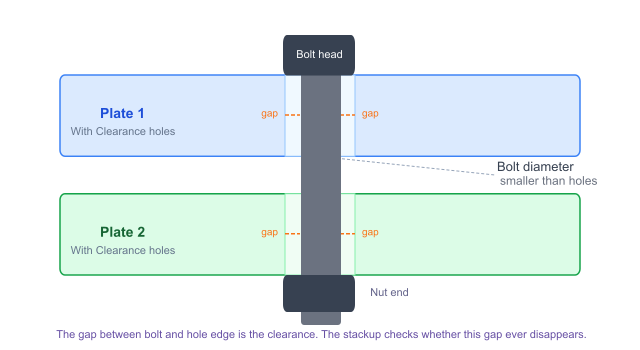 Fig 1 — A bolt passes through two clearance holes. The gap between the bolt and each hole
edge is the clearance. The stackup tells you whether that gap ever disappears.
Fig 1 — A bolt passes through two clearance holes. The gap between the bolt and each hole
edge is the clearance. The stackup tells you whether that gap ever disappears.
The key insight: the hole is bigger than the bolt on purpose. But how much bigger? And what happens when the holes are slightly misaligned? That's the whole calculation.
3. The four things that affect your stackup
In a rectangular clearance hole stackup, exactly four types of input affect the result. Nothing more. Once you understand each one, the rest of the calculation is arithmetic.
3a. Hole nominal diameter and EBT (Equal Bilateral Tolerance)
Every hole on a drawing has a nominal size — the intended diameter. For example, a hole might be called out as Ø10.5 mm. But manufacturing isn't perfect, so there's also a tolerance — a permitted range around that nominal.
EBT stands for Equal Bilateral Tolerance. It means the hole is allowed to vary equally above and below nominal. An EBT of 0.2 mm means the hole can be anywhere from 10.3 mm to 10.7 mm.
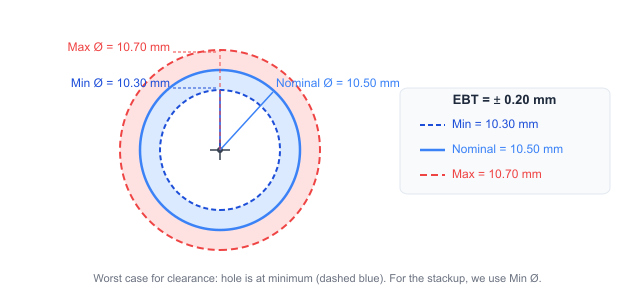 Fig 2 — A nominal hole of Ø10.5 mm with EBT = 0.20 mm. The hole can be anywhere between
the dashed inner circle (min) and dashed outer ring (max). In the worst case for clearance,
the hole is at its minimum — the dashed blue line.
Fig 2 — A nominal hole of Ø10.5 mm with EBT = 0.20 mm. The hole can be anywhere between
the dashed inner circle (min) and dashed outer ring (max). In the worst case for clearance,
the hole is at its minimum — the dashed blue line.
For a bolt to fit through a hole, the worst case for the stackup is when the hole is at its smallest. So the calculation always considers the minimum possible hole size.
If the tolerance is the same on both sides of nominal (e.g. ±0.1), it's called bilateral equal. Some drawings use different upper and lower deviations — like +0.3 / −0.1. The tool handles both. EBT is just a shorthand for the symmetric case.
3b. Positional tolerance (X and Y)
Even if a hole is the right size, it might be drilled in the wrong place. A hole that is 5 mm too far to the left won't line up with the bolt, even if the hole is big enough.
On engineering drawings, hole locations are controlled by positional tolerances. In a rectangular (X/Y) system, the drawing specifies how far the hole centre is from a reference point, and how much that position is allowed to vary — separately in the X direction and Y direction.
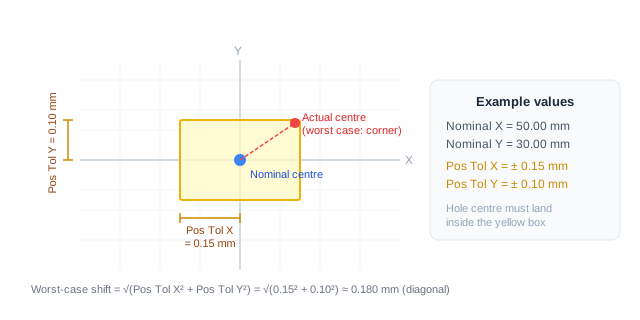 Fig 3 — The yellow rectangle is the positional tolerance zone. The hole centre must land
anywhere inside this box. When it lands in a corner, the centre has shifted the maximum
possible distance from nominal — this is the worst case.
Fig 3 — The yellow rectangle is the positional tolerance zone. The hole centre must land
anywhere inside this box. When it lands in a corner, the centre has shifted the maximum
possible distance from nominal — this is the worst case.
The worst-case shift distance from nominal is not just X or Y — it's the diagonal, because the hole could be at its maximum X and maximum Y at the same time. That diagonal is calculated using the Pythagorean theorem:
This calculated diagonal becomes the EBT (Equivalent Bilateral Tolerance) for the two tolerances in X and Y direction.
3c. Coating thickness
If your parts are painted, zinc-plated, galvanised, or have any surface coating, the coating grows on the inside of the hole too. This reduces the effective hole diameter — the space the bolt actually has to pass through.
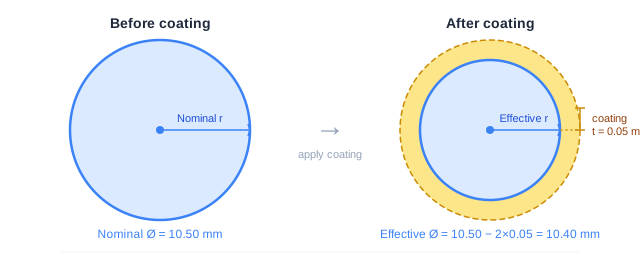 Fig 4 — Coating grows on all surfaces, including the inside of a hole. A 0.05 mm coating
reduces the hole diameter by 0.10 mm (2 × coating) because it coats both sides.
Fig 4 — Coating grows on all surfaces, including the inside of a hole. A 0.05 mm coating
reduces the hole diameter by 0.10 mm (2 × coating) because it coats both sides.
3d. Bolt camber
A long bolt is never perfectly straight. Even if it came from the factory straight, it flexes slightly under its own weight and during assembly. This slight bow is called bolt camber. For a long bolt through two misaligned holes, camber means the bolt pushes on the edge of one hole as it tries to straighten.
The camber contribution is estimated from bolt length and diameter:
4. The clearance that matters
Before we can calculate whether the bolt fits, we need to define what "clearance" means in this context. The key number is:
If the bolt diameter is 10 mm and the effective hole (after coating) is 10.4 mm, the available clearance is 0.4 mm. That 0.4 mm of space has to accommodate:
- Any misalignment between the two holes (from positional tolerance)
- Any reduction from hole size variation (from EBT)
- Any bolt bowing (camber)
If the combined effect of all those is less than the available clearance, the bolt fits. If it is more, the bolt won't pass through both holes simultaneously.
5. The worst-case calculation — step by step
The worst-case method assumes every single tolerance is at its most unfavourable extreme at the same time. This is the most conservative approach. If the stackup passes worst-case, you are guaranteed every assembly will work.
Step 1 — Find the effective hole diameter for each plate
Step 2 — Calculate the EBT contribution for each plate
The hole can be smaller than nominal by half the EBT. We work in radial terms throughout (half-diameters), so each plate contributes half its EBT:
Step 3 — Calculate the position contribution for each plate
Step 4 — Add bolt camber
Step 5 — Sum all tolerance contributions
Step 6 — Compare with available clearance
The minimum effective hole (worst case) is 10.40 mm. Available clearance is 10.40 − 10.00 = 0.40 mm. Total variation is 0.580 mm — it exceeds the clearance:
A negative minimum gap means there are combinations of tolerances where the bolt will not pass through both holes. The design needs to be revised — bigger holes, tighter tolerances, or a shorter bolt.
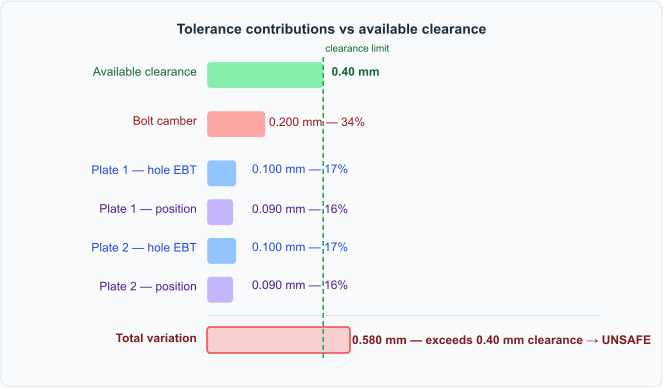 Fig 5 — The bolt camber is the single largest contributor at 34% of total variation.
Combined variation (0.58 mm) exceeds the available clearance (0.40 mm),
giving a worst-case gap of −0.18 mm (UNSAFE).
Fig 5 — The bolt camber is the single largest contributor at 34% of total variation.
Combined variation (0.58 mm) exceeds the available clearance (0.40 mm),
giving a worst-case gap of −0.18 mm (UNSAFE).
6. The RSS method — a more realistic view
The worst-case method assumes every tolerance is at its worst extreme simultaneously. In reality, that almost never happens. If you're producing thousands of assemblies, the chance that every single part lands at its worst tolerance simultaneously is extremely small.
The RSS method (Root Sum of Squares) is a statistical approach. It treats each tolerance as an independent random variable and calculates the combined variation using the square root of the sum of squares:
This RSS variation (0.276 mm) is much smaller than the worst-case variation (0.580 mm). It falls within the available clearance of 0.40 mm, so the RSS analysis predicts the assembly will pass in most cases. The tool then converts this into a yield percentage using a Z-score calculation.
Use worst-case for safety-critical joints, low-volume production, or when tolerances are controlled by manual setup. Use RSS as a realistic prediction for high-volume manufacturing where parts are produced on well-controlled CNC machines.
7. Understanding your results
The tool gives you four key numbers:
| Result field | What it means |
|---|---|
| Min gap (worst-case) | The smallest possible clearance when every tolerance is at its worst. If negative, some assemblies will fail. |
| Max gap (worst-case) | The largest possible clearance. Useful to know, but rarely the design concern. |
| Status: SAFE / UNSAFE | SAFE means even the worst case clears the bolt. UNSAFE means some combinations fail. |
| Statistical yield % | The probability that a randomly assembled joint will pass — based on RSS assumptions. |
If the worst-case says UNSAFE but the statistical yield is 99.9%, you may be able to accept the design — depending on the consequences of a failed assembly. For a bolt pattern on a pressure vessel nozzle, you'd demand worst-case SAFE. For a non-structural cover plate, 99.8% statistical yield might be perfectly acceptable.
8. The GD&T connection
So far we've talked about positional tolerance in X/Y coordinates (rectangular dimensions). Modern drawings often use GD&T — Geometric Dimensioning and Tolerancing instead. GD&T is a drawing language standardised in ASME Y14.5 (US) and ISO 1101 (international). Here's how it connects.
The position callout
In GD&T, a hole's location is controlled with a position tolerance symbol in a feature control frame. This is what it looks like on a drawing:
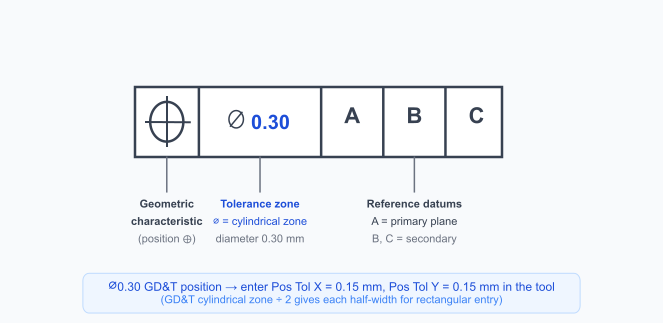 Fig 6 — A GD&T position feature control frame. The ⊕ symbol means position,
⌀0.30 means the hole centre must fall within a cylindrical tolerance zone of ⌀0.30 mm,
referenced to datums A, B, C.
Fig 6 — A GD&T position feature control frame. The ⊕ symbol means position,
⌀0.30 means the hole centre must fall within a cylindrical tolerance zone of ⌀0.30 mm,
referenced to datums A, B, C.
Cylindrical vs rectangular tolerance zone
The key difference from X/Y rectangular tolerancing: a GD&T position callout with the ⌀ symbol defines a cylindrical tolerance zone. The hole centre must land within a cylinder of diameter 0.30 mm centred on true position. This is about 57% more efficient than the equivalent rectangular zone.
When you have a GD&T position callout, convert it to the tool's X/Y input like this:
Bonus tolerance at MMC
GD&T offers an additional benefit: when a hole is at its Maximum Material Condition (MMC) — its smallest size — the positional tolerance must be met strictly. But as the hole grows larger (departing from MMC), you gain extra positional tolerance. This is called bonus tolerance.
| Hole size | Stated position tol (⌀) | Bonus | Total position tol |
|---|---|---|---|
| 10.30 mm (MMC) | ⌀0.30 | 0 | ⌀0.30 |
| 10.40 mm | ⌀0.30 | ⌀0.10 | ⌀0.40 |
| 10.50 mm (nominal) | ⌀0.30 | ⌀0.20 | ⌀0.50 |
| 10.70 mm (LMC) | ⌀0.30 | ⌀0.40 | ⌀0.70 |
The Datum Shift module in the tolerance stackup tool handles full GD&T bonus tolerance budgeting. For the clearance rectangular module, enter the position tolerance that corresponds to the worst-case hole size (MMC) to stay conservative.
9. How to improve a failing stackup
If the tool shows UNSAFE, there are several ways to fix it. The contributor chart shows which tolerance is the biggest offender — start there.
| What to change | Effect | Typical impact |
|---|---|---|
| Increase hole diameter | More available clearance | High |
| Tighten positional tolerance | Reduces position contribution | High |
| Shorten bolt / reduce bolt length | Reduces camber contribution | Medium |
| Reduce coating thickness | More effective hole diameter | Medium |
| Tighten hole EBT | Reduces EBT contribution | Medium |
| Use a smaller diameter bolt | More available clearance | Situational |
After running a calculation, the tool's optimiser panel suggests which tolerances to tighten and by how much to reach a passing result. It ranks suggestions by contribution percentage — so you're always working on the highest-impact change first.
10. A complete worked example
Two 6 mm thick steel plates. M10 bolts, zinc-plated. Plate holes drilled on a CNC mill.
| Parameter | Plate 1 | Plate 2 |
|---|---|---|
| Hole nominal Ø | 11.00 mm | 11.00 mm |
| Hole EBT | 0.18 mm | 0.18 mm |
| Zinc coating | 0.012 mm | 0.012 mm |
| Pos Tol X | 0.10 mm | 0.10 mm |
| Pos Tol Y | 0.10 mm | 0.10 mm |
| Bolt: M10, nominal Ø = 10.00, max Ø = 10.058 mm (ASME B18.2.1), length = 40 mm | ||
Worst-case minimum gap is +0.356 mm. Every possible assembly combination will clear the bolt. Statistical yield will be close to 100%.
Summary
The entire clearance hole rectangular stackup in six steps:
- Find the effective hole Ø for each plate — nominal minus 2× coating.
- For each plate, calculate the EBT term = 0.5 × EBT.
- For each plate, calculate the position term = 0.5 × √(Pos Tol X² + Pos Tol Y²).
- Add bolt camber = 0.006 × length + max body overage.
- Worst-case check — if the sum of all terms exceeds (min effective hole − bolt nominal Ø), the stackup fails.
- Statistical check — use RSS of all terms to estimate yield probability.
If the result is failing, look at the contributor chart and reduce the largest term first.
Try it in the tool
The Clearance Hole Rectangular Stackup calculator on enggtools.in handles all of this automatically. Enter your dimensions, run the calculation, and get worst-case and statistical results with a ranked contributor chart.
Open the Tolerance Stackup Tool →Disclaimer: This article is for educational purposes. Always have your tolerance analysis reviewed by a qualified engineer before using it in safety-critical applications. The formulas shown are standard mechanical engineering methods — they do not replace a full drawing review, material analysis, or formal design verification.