article
Chains and sprockets: why most bicycles still use them
A practical introduction to roller-chain drives, including bicycle gearing, chain pull, wear, failure clues, and why belts remain a specialist alternative.
Published Jul 13, 2026
A cyclist can press a pedal with several hundred newtons of force, yet the narrow loop beside the rear wheel transmits that effort with remarkably little loss. That loop works in rain, grit, sudden hill starts, and repeated gear changes. It is not simply an old-fashioned belt made from steel: a roller chain and its sprockets form a positive-engagement transmission with a distinctive set of strengths and compromises.
Belts are excellent machine elements, and a few bicycles do use toothed belts. Most bicycles still use chains because chains package high force into a narrow space, tolerate small sprockets, need little installation tension, can be opened for assembly, and work naturally with derailleur gearing. Understanding that choice is a useful introduction to chain drives in conveyors, packaging machines, agricultural equipment, and industrial power transmission.
What actually carries the load?
A roller chain is built from alternating inner and outer links. Pins join the outer plates, bushes support the pins, and rollers rotate around the bushes. When the chain reaches a sprocket, each roller settles between two teeth. The tooth does not grip by friction as a smooth pulley grips a flat belt. Instead, its curved working surface pushes directly against a roller. This is called positive engagement: under normal conditions the chain cannot creep around the sprocket.
The distance between adjacent pin centers is the pitch, written as p. A common bicycle-chain pitch is 12.7 mm. The sprocket tooth spacing must match it. If a sprocket has z teeth, one revolution advances exactly z pitches of chain, so the average chain speed is:
v = p z n / 60
Here v is chain speed in m/s when p is in metres and n is shaft speed in revolutions per minute. Because the same chain passes both sprockets, their average chain speed is equal. This gives the familiar speed relationship:
driven speed / driver speed = driver teeth / driven teeth
The chain does not wrap around a perfectly smooth pitch circle, but engineers use a theoretical pitch circle through the roller centers. Its radius is:
r = p / [2 sin(180 degrees / z)]
This relation matters because chain pull and shaft torque are linked by T = F r. A smaller sprocket has a smaller pitch radius, so the same shaft torque produces greater chain pull. Very small sprockets also make each link articulate through a larger angle, increasing vibration and joint wear.
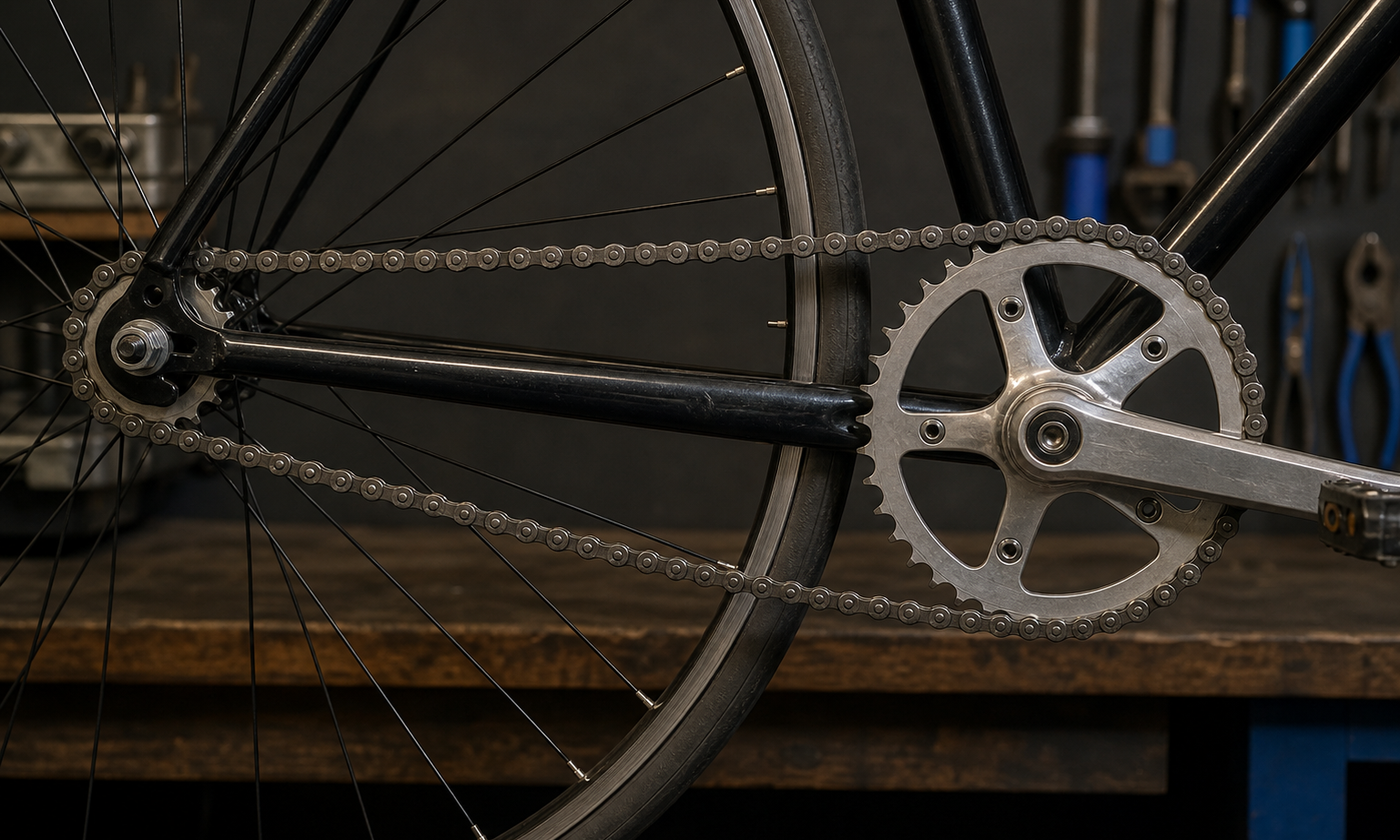
Figure 1. A bicycle chain uses positive tooth-to-roller engagement. The straight upper span normally carries the driving pull; the lower return span needs controlled slack rather than high belt-like preload.
Worked example 1: from pedal torque to road force
Consider an invented commuter bicycle with a 42-tooth chainring, an 18-tooth rear sprocket, 12.7 mm chain pitch, 0.340 m loaded wheel radius, and a cadence of 80 rpm. Assume the rider supplies a steady 32 N·m crank torque. We will neglect drivetrain loss at first so the mechanism is easy to see.
First find the front pitch radius:
front pitch radius = 0.0127 / [2 sin(180 degrees / 42)] = 0.0849 m
The approximate tight-side chain pull is therefore:
F = T / r = 32 / 0.0849 = 377 N
The rear pitch radius is:
rear pitch radius = 0.0127 / [2 sin(180 degrees / 18)] = 0.0366 m
So the ideal torque delivered to the rear sprocket is 377 × 0.0366 = 13.8 N·m. The wheel rotates faster than the crank because the front sprocket has more teeth:
wheel speed = 80 × 42 / 18 = 186.7 rpm
The wheel circumference is 2π × 0.340 = 2.136 m, giving a road speed of 186.7 × 2.136 / 60 = 6.65 m/s, or about 23.9 km/h. The ideal tractive force at the tyre is 13.8 / 0.340 = 40.6 N. Real bearing, chain, and tyre losses reduce the delivered value, and acceleration or climbing creates fluctuating rather than perfectly steady pull. Still, the example shows how a narrow chain can carry hundreds of newtons while trading pedal torque for wheel speed.
Why a chain suits a bicycle so well
High load in a small width. Steel pins, bushes, rollers, and plates carry tensile load efficiently. A bicycle drive can therefore remain narrow enough to clear the rider, tyre, and frame. A toothed belt capable of the same peak duty generally needs more width and larger pulleys, especially where tooth fatigue and jump resistance govern the design.
Little installation preload. A friction belt needs initial tension so it can develop traction. A toothed belt does not depend mainly on friction, but it still needs controlled tension to keep its teeth seated and prevent ratcheting. Chain teeth pull directly on rollers, so the return span may retain modest slack. Lower preload helps limit constant radial load on the bottom bracket and rear hub bearings.
Small sprockets and easy ratio changes. A chain can work on relatively small sprockets, which helps fit a wide ratio range into a compact cassette. A derailleur moves the chain sideways from one sprocket to another while its spring-loaded cage takes up the changing chain length. A wide toothed belt resists lateral movement and cannot be shifted across exposed pulley stacks in the same simple way.
Practical assembly. A chain can be separated at a joining pin or reusable link and installed through an ordinary closed rear triangle. A belt is normally endless because a field joint would disturb its tensile cords and tooth pitch. The bicycle frame therefore needs a designed opening if a belt must pass inside the rear triangle.
Service in dirt and water. Dirt is harmful to any transmission, but the open geometry around chain rollers can shed particles and accept fresh lubricant. A belt runs clean and does not need oil, yet stones trapped between belt and pulley can damage teeth or tensile cords. Both systems need correct alignment; the narrow chain is simply more forgiving of the rough, repairable architecture used on many bicycles.
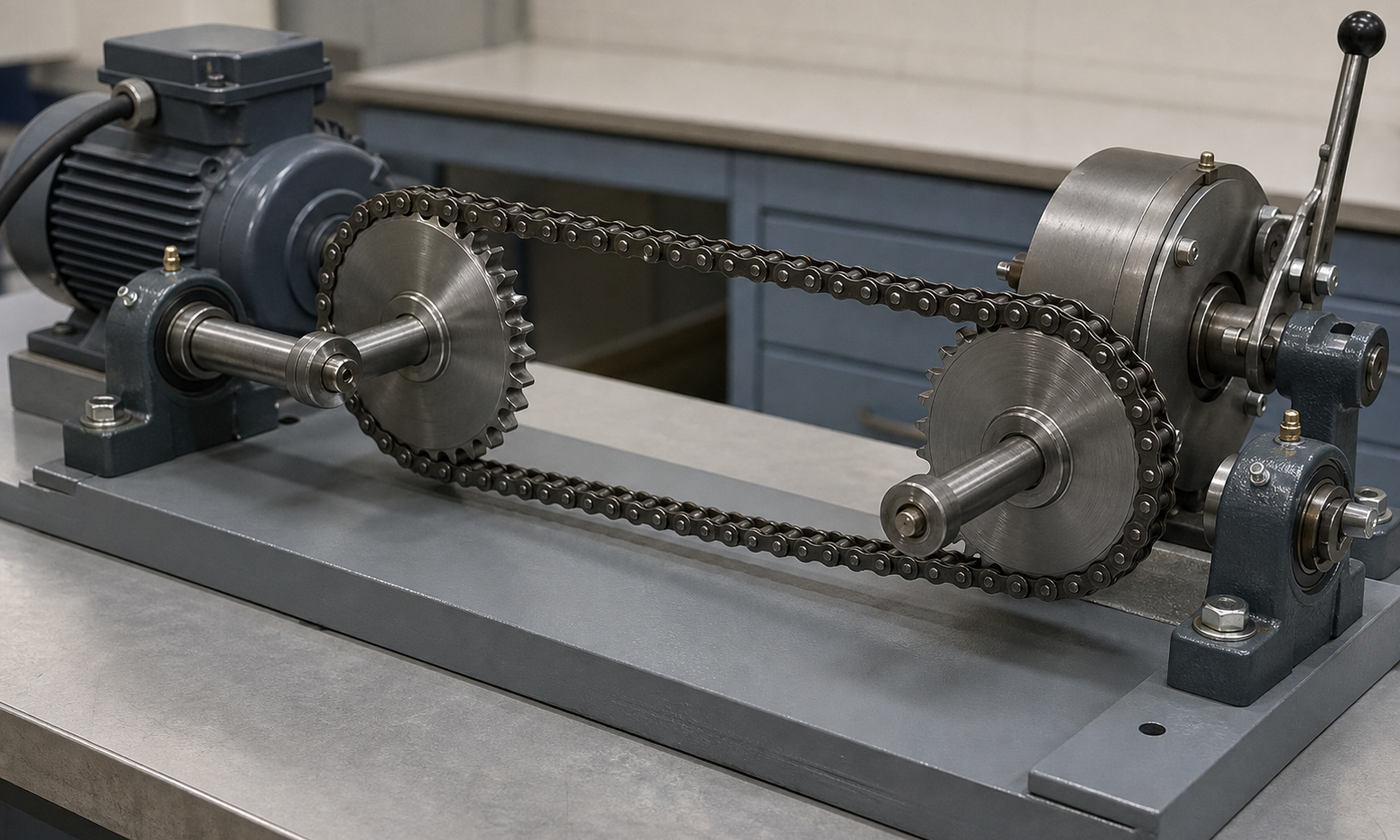
Figure 2. A laboratory chain rig makes the load path visible: torque enters one shaft, the tight span carries useful pull, and the second sprocket delivers torque to the loaded shaft.
Worked example 2: screening an industrial chain drive
Suppose a small mixer motor delivers 2.2 kW at 960 rpm to a 17-tooth driver sprocket. The driven sprocket has 51 teeth, and the selected chain pitch is 12.7 mm. This is an invented preliminary calculation; final selection would use a chain manufacturer's rated-power method, lubrication category, shaft spacing, duty, and safety requirements.
The output speed is:
output speed = 960 × 17 / 51 = 320 rpm
The average chain speed is:
v = 0.0127 × 17 × 960 / 60 = 3.45 m/s
Power equals force times velocity, so the ideal effective chain pull is:
effective pull = P / v = 2200 / 3.45 = 637 N
If the mixer has moderate starting shock and the preliminary service factor is 1.5, the design pull for an initial screen becomes 637 × 1.5 = 956 N. The ideal output torque provides a useful cross-check:
output torque = 9550 P / n = 9550 × 2.2 / 320 = 65.7 N·m
Using the 51-tooth pitch radius, about 0.103 m, gives 956 × 0.103 = 98.5 N·m at the service-factor load. That is higher than the steady 65.7 N·m by the intended factor of 1.5. The engineer would now check an actual chain rating, likely wear life, sprocket tooth count, shaft and bearing loads, centre distance, lubrication, guarding, and start-stop frequency. The arithmetic does not select a safe chain by itself; it organizes the questions.
The polygon effect and why tooth count matters
As a chain wraps a sprocket, straight pitch segments form a many-sided polygon rather than a true circle. The effective radius therefore changes slightly as each tooth passes the engagement point. This polygon effect, also called chordal action, causes small speed fluctuations even when the driving shaft rotates steadily. More teeth make the polygon closer to a circle and reduce the fluctuation.
That is one reason designers avoid extremely small driver sprockets. Fewer teeth may reduce size and cost, but they increase articulation angle, impact, noise, and wear. Many general industrial designs start their search near 17 teeth or more on the small sprocket, then adjust using the selected chain system's guidance. A bicycle derailleur drive accepts smaller rear sprockets because compact gearing, low mass, and a specialized chain matter greatly, but it also receives frequent maintenance and has a finite wear life.
Assumptions that can quietly break the calculation
- Steady power: Pedalling, piston machines, and indexing drives create peaks. Average kilowatts can hide the load that controls plate fatigue or tooth impact.
- Perfect alignment: Sprocket faces must be parallel and their tooth planes aligned. Misalignment loads one side of the chain plates and polishes one sprocket face.
- Correct slack: A chain pulled guitar-string tight overloads bearings and accelerates wear. Excessive slack whips, strikes guards, and may climb teeth.
- Clean, effective lubrication: Oil must reach the pin-bush bearing surfaces. A shiny coating outside the rollers does not prove that the working joints are lubricated.
- Compatible parts: Matching nominal pitch is not enough. Roller diameter, inner width, tooth form, chain series, and sprocket thickness must also suit one another.
Failure modes and the clues they leave
Engineers often say a chain has "stretched," but normal service wear rarely means the steel plates have plastically elongated. Wear removes material from the pin and bush interfaces, increasing the pitch of each joint. Across many links, those tiny increases become measurable. The worn chain then rides higher on the sprocket teeth, concentrates load near the tips, and reshapes the working flanks into a hooked profile.
Stiff links usually point to corrosion, contamination, damaged plates, or poor lubrication. Reddish-brown debris around joints can indicate fretting and inadequate oil supply. Cracked plates or loose pins are urgent signs of overload, fatigue, or an assembly problem. Side polishing suggests misalignment. Repeated clicking under load may come from a stiff joint, damaged tooth, incompatible replacement part, or a chain that has worn beyond the sprocket pitch.
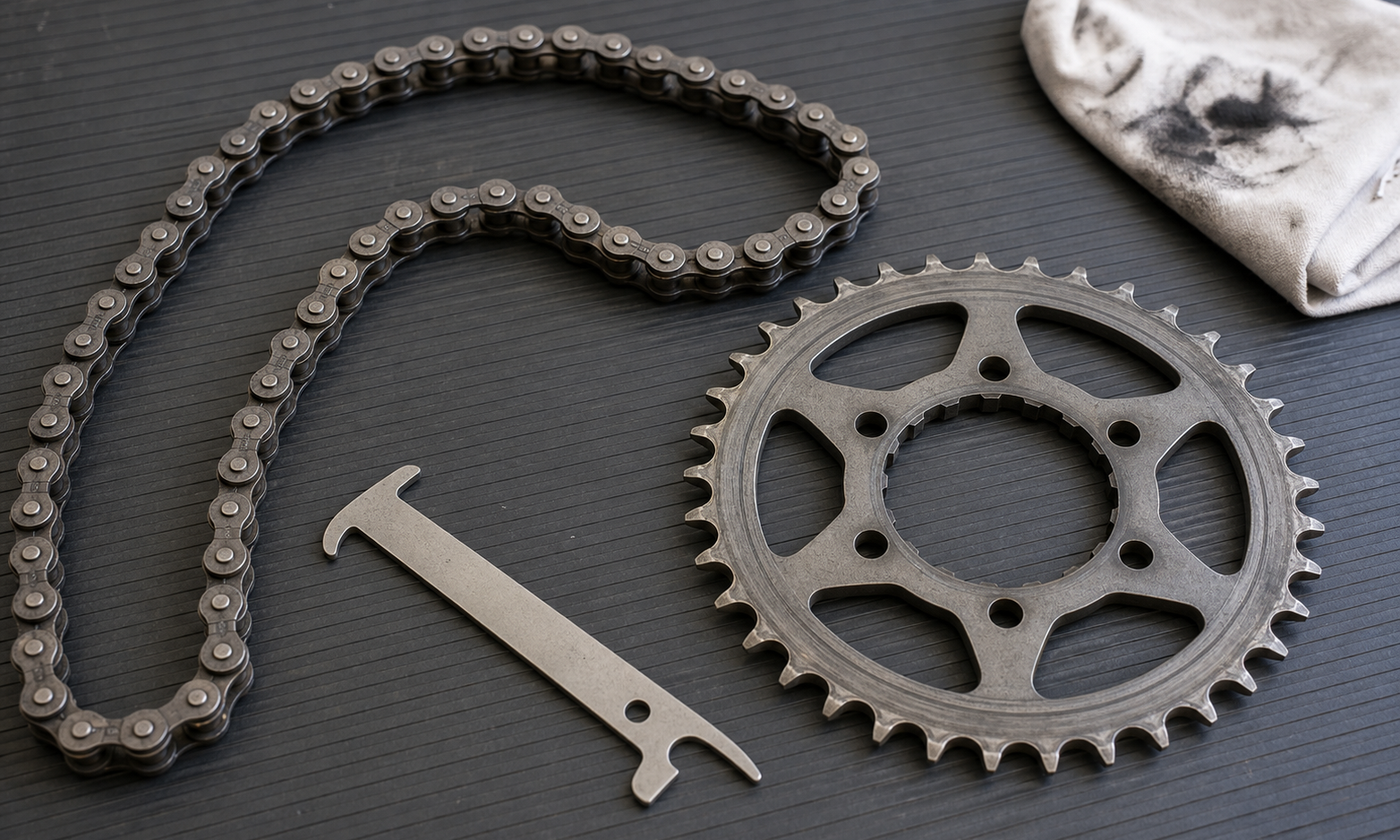
Figure 3. Chain wear accumulates at many pin and bush joints. Measuring several pitches is more informative than judging the outside appearance alone, and worn chain and sprocket surfaces should be assessed as a working pair.
Practical installation and maintenance guidance
- Use a straightedge or alignment tool across the sprocket faces, and confirm that both shafts are parallel.
- Provide an adjustment method for centre distance or use a properly located tensioner on the slack span.
- Measure wear across a substantial number of pitches under light tension. A longer gauge length reduces the influence of clearance at one joint.
- Lubricate at the chain edges so oil can enter the pin-bush interfaces; choose viscosity and delivery method for speed, temperature, and contamination.
- Replace sprockets when tooth wear would prevent a new chain from seating correctly. A new chain on badly hooked teeth can run roughly and wear rapidly.
- Guard industrial chains against accidental contact and contain a failed chain, while retaining safe inspection and lubrication access.
How standards treat chains and bicycles
ISO 606 establishes principal dimensions, measurement conventions, and related sprocket information for short-pitch precision roller chains used in power transmission and conveying. It supports interchangeability, but a standard designation does not replace application design: power rating, lubrication, duty factor, temperature, corrosion, and guarding still belong to the machine designer.
Bicycle safety standards in the ISO 4210 series treat the cycle as a complete product and include requirements and test methods relevant to the drive system, cranks, pedals, and structural safety. They do not mean that every bicycle should use one transmission architecture. A chain, belt, hub gear, or other arrangement must be integrated so the finished bicycle remains safe and durable for its intended use. Designers should use the current applicable edition, regional rules, and component manufacturer's instructions rather than copying a remembered limit from an old project.
So, can a bicycle use a belt?
Yes. A modern toothed bicycle belt can be quiet, clean, corrosion-resistant, and low-maintenance. It is particularly attractive on a single-speed bicycle or one with an internally geared hub. The trade-offs are a frame opening for the endless belt, accurate alignment, controlled tension, generally larger pulleys, limited roadside repair, and no ordinary derailleur shifting. The correct conclusion is not that chains are universally better. Chains better match the packaging, gearing, repairability, and cost priorities of most bicycles.
Engineering judgment: design the whole load path
A chain drive should not be chosen from tensile strength alone. Start with speed ratio, power, smallest sprocket, duty cycle, and available space. Then examine dynamic peaks, articulation, alignment, lubrication, wear allowance, bearing loads, adjustment, guarding, and maintenance access. The best transmission is the one whose predictable weaknesses the machine can tolerate and the owner can manage.
For a bicycle, the familiar steel chain survives because it balances those requirements unusually well. For the next step, explore more practical machine-design explanations and calculators in the EnggTools engineering articles library.