article
1D Linear Tolerance Stackup: Will the Parts Fit in the Envelope?
Will the parts always fit in the envelope? Worst-case and RSS methods for 1D chains, with the sign conventions that prevent the most common stackup errors.
Published Jun 12, 2026 - Maintained by Ashish Kapoor
This technical page is maintained by Ashish Kapoor, a project engineering lead. Use it as a learning and calculation-review aid, then verify critical work against current standards, project documents, supplier data, and competent engineering review.
Found an assumption, unit, formula, or standards-reference issue? Send the page URL through the contact page so it can be corrected.
The 1D linear chain is the most common tolerance stackup in mechanical design. Several child components sit end-to-end inside one parent envelope — bearings and spacers on a shaft, plates in a housing, cells in a battery pack — and you need to know whether the chain always fits, and how big the leftover gap can get. This article explains the method used by the 1D Linear Chain module in the enggtools.in Tolerance Stackup tool.
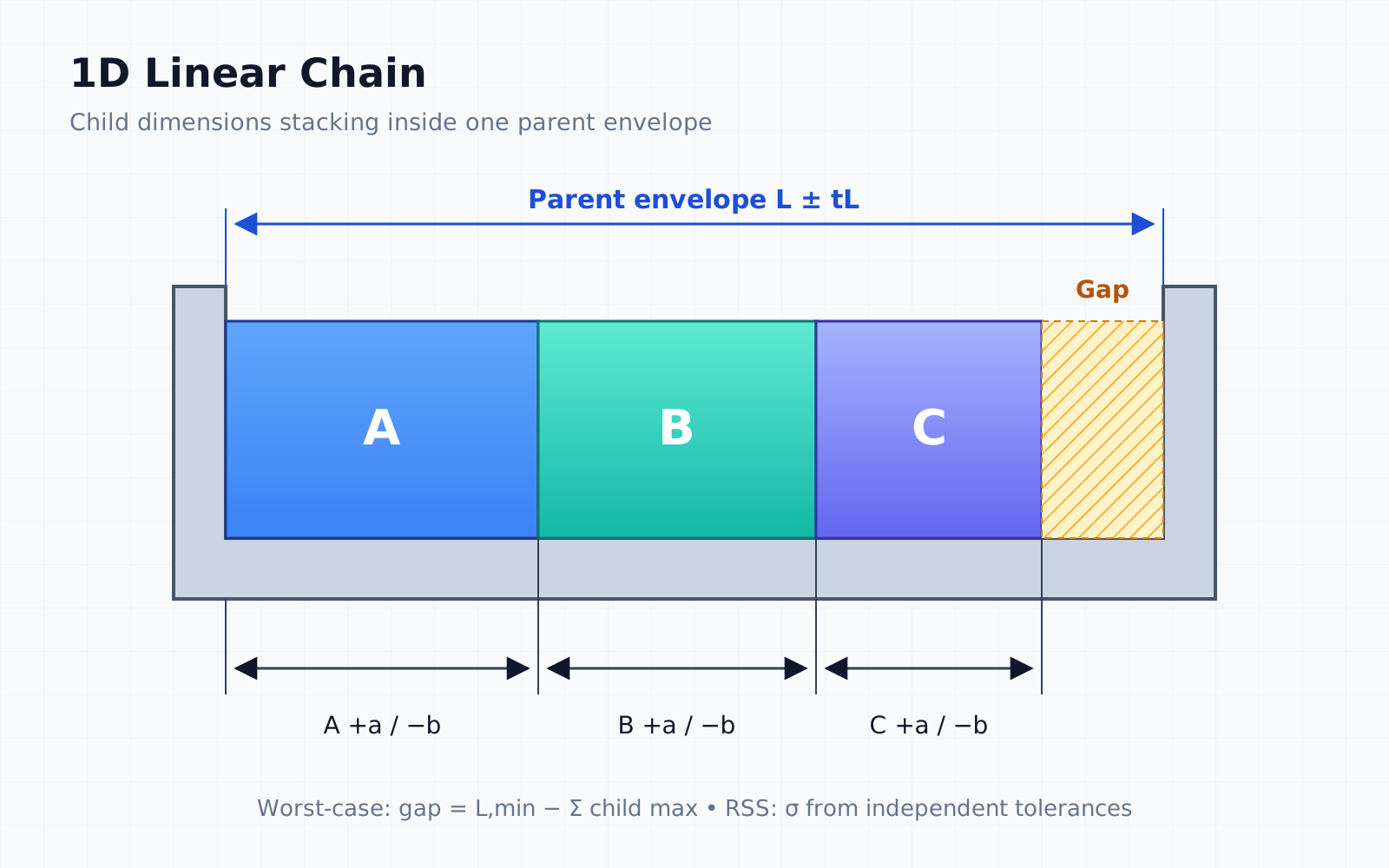
The setup: parent, children, and a gap
Every 1D stackup has the same three ingredients. The parent envelope is the available space — an internal length L with its own tolerance. The child dimensions are the parts that consume that space, each with a nominal value and a plus/minus tolerance. The gap (or slack) is what remains: parent minus the sum of the children. The whole analysis is about bounding that gap.
Each dimension also carries a sensitivity. In a simple end-to-end chain the sensitivity is +1 for dimensions that consume space and −1 for dimensions that add space back (for example, a groove). If a part appears twice — two identical spacers — you can give it a sensitivity of 2 instead of entering it twice.
Sign convention: the lower deviation is always negative
A frequent source of stackup errors is the sign of the lower deviation. On a drawing, a dimension like 8 +0.1/−0.1 has an upper deviation of +0.1 and a lower deviation of −0.1. Many engineers type the lower value as "0.1" without the minus sign, which would silently shrink the tolerance band to zero. The enggtools.in module removes this trap: the "minus tolerance" field is always applied as a negative deviation, whatever sign you type. Entering 0.1 or −0.1 gives the same correct band of 7.9 to 8.1.
Worst-case method
The worst-case (WC) gap assumes every dimension lands at its least favorable limit at the same time:
Minimum gap = parent minimum − Σ (child maximum)
Maximum gap = parent maximum − Σ (child minimum)
If the minimum gap is at or above your lower acceptance limit (usually zero — the parts must physically fit), the design passes deterministically. Worst-case is the right release criterion for safety-critical fits and for short chains, because it guarantees assembly for every combination of in-tolerance parts.
RSS (statistical) method
For longer chains, worst-case becomes pessimistic: it is statistically unlikely that ten independent dimensions all sit at their extreme limits simultaneously. The root-sum-square (RSS) method treats each tolerance as an independent random variable and combines half-bands as:
RSS half-band = √( Σ (sensitivity × half-tolerance)² )
The module converts the RSS band to a standard deviation (σ = half-band / 3), then computes the probability that the gap stays inside your acceptance limits and compares that yield against your target (95% by default). RSS is an estimate, not a guarantee — it assumes contributors are independent, roughly centered, and normally distributed. If your process data does not support those assumptions, release on worst-case.
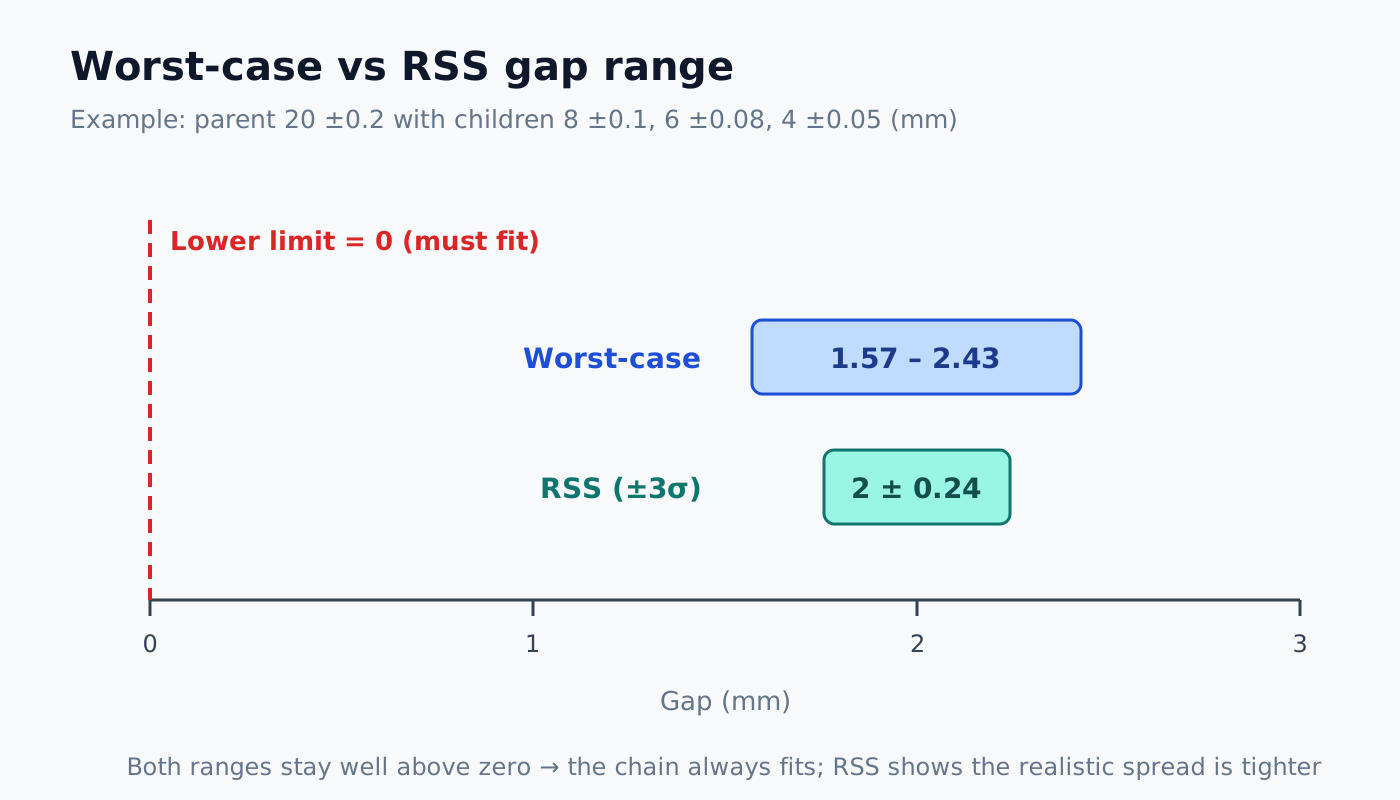
Worked example
A parent opening of 20 ±0.2 mm must accept three stacked parts: 8 ±0.1, 6 ±0.08, and 4 ±0.05 mm. The lower acceptance limit on the slack is 0 (parts must fit).
Worst case: the parent can be as small as 19.8 mm while the children stack up to 8.1 + 6.08 + 4.05 = 18.23 mm, leaving a minimum slack of 1.57 mm. At the other extreme the slack reaches 20.2 − 17.77 = 2.43 mm. The chain always fits — worst-case PASS.
RSS: the centered gap is 20 − 18 = 2 mm and the RSS half-band is √(0.2² + 0.1² + 0.08² + 0.05²) = 0.243 mm, giving σ ≈ 0.081 mm. The lower limit sits almost 25 standard deviations away, so the statistical yield is effectively 100%.
Reading the results
The module reports both methods side by side. Use the worst-case PASS/FAIL as your design-release gate. Use the RSS yield to judge how much margin you really have, and to decide whether tolerances can be relaxed to cut cost. The contributor chart shows which dimension dominates the variation — tightening the biggest contributor is always the most efficient fix.
Try your own chain in the free Tolerance Stackup tool on enggtools.in — add dimensions, set sensitivities, and get worst-case and RSS results with a full calculation report.